

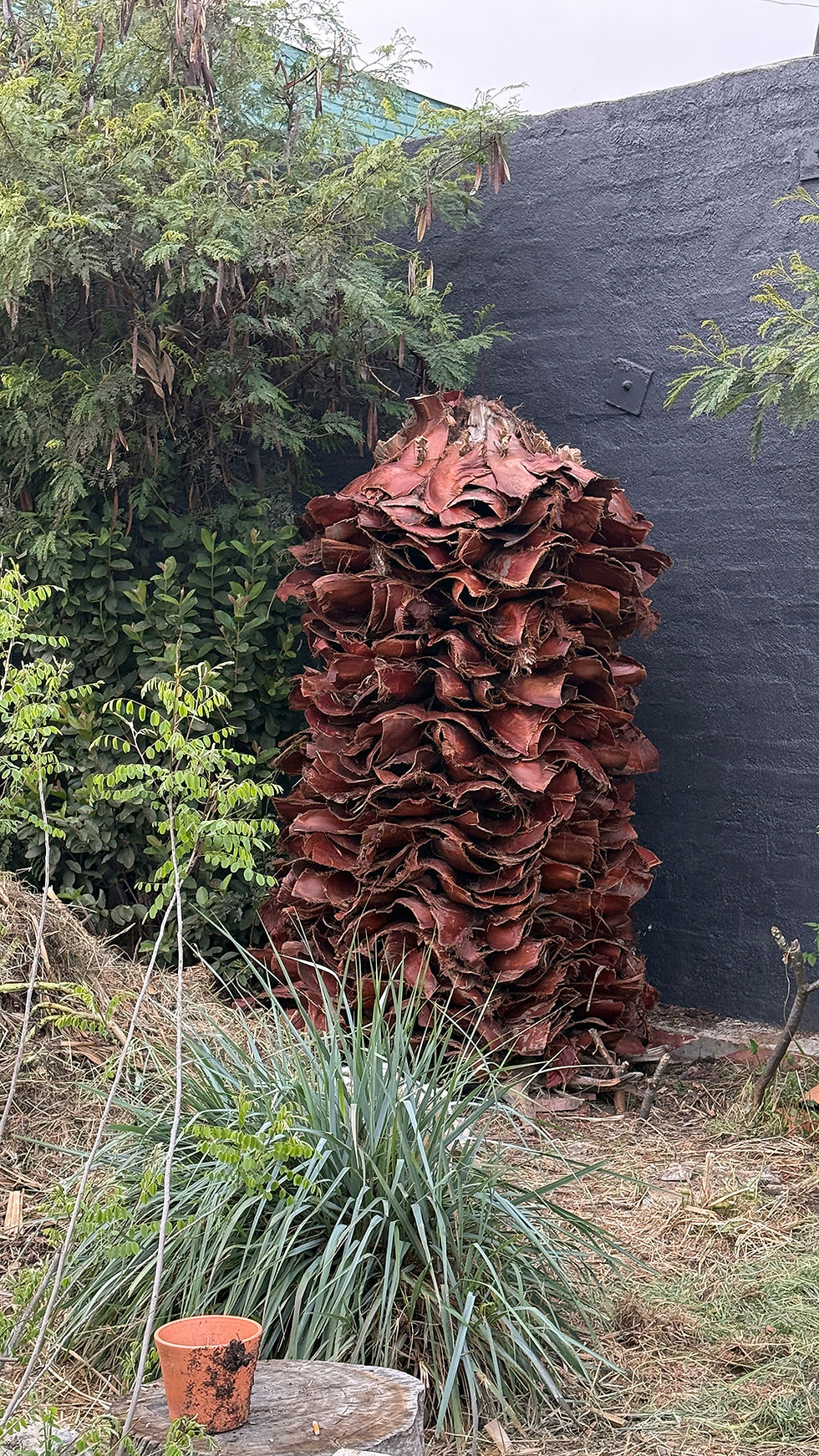



PALM SCULPTURE, 2025
When I first came West from my snug New England village, I was stunned. I’d devoured descriptions of this place in poems and novels of writers such as Gary Snyder and Jack Kerouac, but arriving in California after a three-day marathon in a drive-away car with a broken starter (we didn’t turn off the engine from Memphis until we arrived in California), I was knocked out by hedges on the streets of Claremont of living Jade Plant. I’d only ever seen this growing as a houseplant in a clay pot. Here in California it was alive, thriving outside, reproducing, untamed, independent. If this was possible, what else might be here?
That was forty years ago. A cutting from that Claremont Jade Plant has grown into a huge houseplant in our home in Northern New Mexico, its stem thicker than my wrist. Now I find myself back in California, spending more time here than I have for years. Again I have an outsider’s view, that ability to see with fresh eyes that might diminish with familiarity. Now it is the Palms that have my attention.
Out here on the edge of the continent, millions have arrived to follow dreams, realize fantasies, and sell dreams of possibility and desire to the world (movies, surfing, celebrity, and the weather). As a part of this cultural matrix, palm trees hold strong symbolism, an icon of some dream of sybaritic luxury, a tropical vacation, a stranding on a desert isle, dates and coconuts, all sweet and creamy.
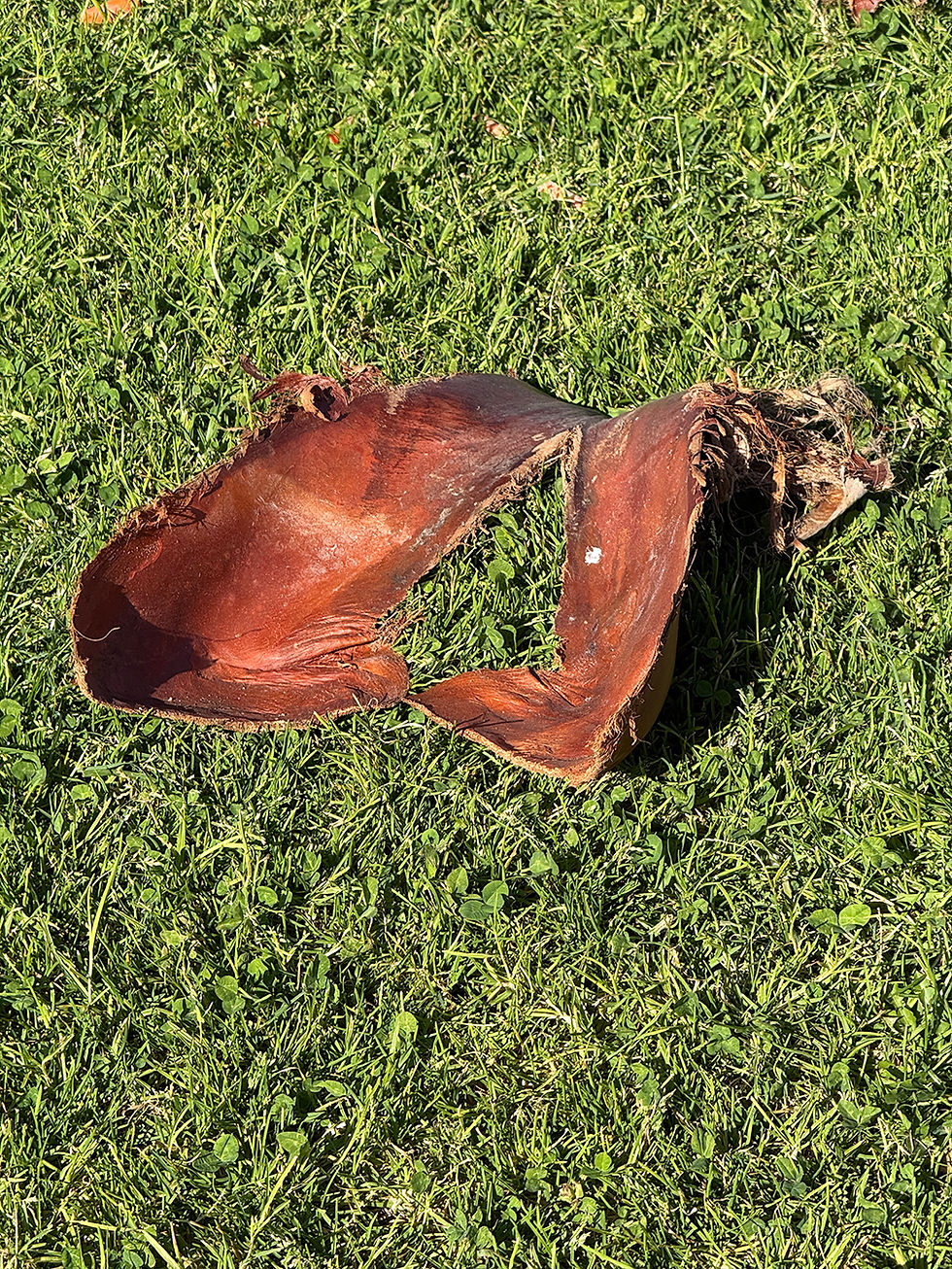
There were big rains here in Los Angeles around the end of 2025, and I found afterwards that parks and beaches and boulevards were inundated with thousands of palm fronds that had come down in the wind and the rain. What most locals see as a nuisance or a danger, I saw as wonderful, beautiful, valuable.
I collected hundreds of these, mostly the small bits that cling to the trees after a frond trimming, but release and fall in a good rain. I scrubbed them clean, dried them in the sun, and stored them away, and let my imagination and dreams guide me in making a plan for them.
David Horvitz had invited me to install an artwork in his 7th Avenue Garden in Arlington Heights, and the palm parts seemed like the material to use. Slowly, I devised a plan to "rebuild" a palm trunk using my cache of local palm.
In the center is a wooden pole (juniper), transported here from New Mexico, strapped to the roof of my car. That pole is set into the ground. I came with a plan to stack the frond bits into a column, as high as I could go in a given time and with a limited number of fronds (It hadn’t rained again since my early January collection). My son Aquila and I worked together, letting the material help to guide the form. The fronds are “backwards,” the portion that once attached to the trunk is on the outside, the part where the long frond stem was cut faces inwards. Six pieces fit well into each layer, and layers alternated in fronds cupped upwards and fronds cupped downwards. Between each layer is adobe, packed in a ring near the center, and made from clay dug in Aquila’s backyard in Glassell Park and mixed with palm frond fiber and water. Near the top, the rings become a bit tighter, and are constructed with five fronds per layer. On the top is a thicker layer of adobe, sculpted into a cone shape. The fronds become shingles above this, double-nailed into the mud with nails made from where the frond stem (petiole) joins the leafy part (rachis).
Over time, the sculpture will disintegrate and the local-sourced organic materials will reintegrate into the local organic environment. Until it does, it will stand in the garden.
-Matthew Chase-Daniel, February 2026
David Horvitz's 7th Avenue Garden: 1911 7th Ave, Los Angeles, CA (map)